Hypochlorous Acid Spray for Sensitive Skin: A Simple Routine Guide
Learn how to place a hypochlorous acid spray in a short AM/PM routine, read the label, and know when to stop and ask a clinician.
In this article
- What Is Hypochlorous Acid Spray, in Plain Terms?
- Cosmetic Mist vs. Medical Product: Know the Difference
- Where Hypochlorous Acid Spray Fits in Your Routine
- How to Use Hypochlorous Acid Spray, Step by Step
- Patch Test First, Even If It Feels Gentle
- What to Pair It With (and What to Space Out)
- How to Choose a pH-Balanced, Alcohol-Free Mist
- Label Red Flags to Skip
- Storage, Shelf Life, and Bottle Hygiene
- Realistic Expectations for Hypochlorous Acid Skin Care
- Who Should Be Careful
- When to See a Doctor
- Hypochlorous Acid Spray FAQ
- Your Simple Starting Plan
A hypochlorous acid spray can feel like the calmest step in a busy skin routine. If your face reacts to almost everything, this light mist might earn a spot on your shelf, as long as you use it the right way.
This guide walks you through where it fits, what to layer with it, and how to read a label before you buy. You will not find miracle promises here. Instead, you will find a practical, cosmetic-only approach to hypochlorous acid skin care that respects sensitive skin and your budget. If fall air leaves your face tight, you can also support your fall skin barrier with a short cream routine.
What you will get from this guide:
- A plain-English explanation of what hypochlorous acid is.
- The exact spot it takes in a morning and evening routine.
- A step-by-step method for how to use hypochlorous acid spray.
- Smart pairings and the actives you should space out.
- A label checklist for picking a pH-balanced, alcohol-free mist.
- Clear signs that you should stop and talk to a clinician.
From Our Garden
I use it on my hands when they get irritated, and it soothes them.
That is one person's experience, not evidence, and your skin may react differently.
What Is Hypochlorous Acid Spray, in Plain Terms?
Hypochlorous acid is a mild, chlorine-based molecule.
In fact, your own body makes it. According to a NIH review of topical hypochlorous, white blood cells called neutrophils release hypochlorous acid as part of the immune response.
That same review notes something useful for shoppers. Above all, the way hypochlorous acid behaves on skin depends heavily on pH and on how stable the formula stays. The authors describe stability as best in a pH range of roughly 3.5 to 5.5. Outside that window, however, the molecule shifts into other compounds.
A hypochlorous acid spray for the face usually holds a very dilute solution in water, sometimes with salt or a buffer to steady the pH. So it feels like plain water, often with a faint pool-like scent that fades fast.
Here is the key idea to keep in mind:
- It is a dilute, water-based mist, not a thick serum.
- Formula stability and pH shape how it performs.
- A gentle feel does not mean every product suits every face.
Cosmetic Mist vs. Medical Product: Know the Difference
The label's intended use matters more than the ingredient.
The U.S. Food and Drug Administration explains this in its page on FDA cosmetic versus drug rules. In short, federal law defines cosmetics as products applied to the body for cleansing, beautifying, promoting attractiveness, or altering the appearance. Drugs, by contrast, aim to diagnose, prevent, or affect disease, or to change the body's structure or function.
The NIH-hosted review mentions that clinicians have used specific hypochlorous acid formulations in medical settings, including wound care. Still, that context does not carry over to the mist on a beauty shelf. A cosmetic mist is not a medical product, and you should not use it as a stand-in for care from a clinician.
Think of a cosmetic hypochlorous acid spray as a refreshing, low-key step. Even so, it cannot replace a diagnosis, a prescription, or a dermatologist's plan for a skin condition.
Where Hypochlorous Acid Spray Fits in Your Routine
Mist right after cleansing and before anything else.
Overall, that simple rule keeps the step useful and easy to remember.
First, clean skin lets the mist reach bare skin with no film in the way. Then serum and moisturizer go on top. A hypochlorous acid spray works best as a thin, early layer, not a final finishing spritz over heavy creams.
Use this order as your base:
- Cleanse with a gentle, fragrance-free cleanser.
- Mist and let it dry, or pat lightly.
- Apply serum, if you use one.
- Apply moisturizer.
- Apply sunscreen in the morning.
| Step | Morning (AM) | Evening (PM) |
|---|---|---|
| 1. Cleanse. | Rinse or gentle cleanser. | Gentle cleanser. |
| 2. Mist. | Hypochlorous acid mist. | Hypochlorous acid mist. |
| 3. Serum. | Light, hydrating serum. | Optional serum. |
| 4. Moisturize. | Lightweight cream. | Richer cream if dry. |
| 5. Protect. | Broad-spectrum SPF. | Skip SPF. |
You can also reach for the mist outside your routine. Some people like a quick spritz after a sweaty workout or after wearing a face mask for hours, purely as a cosmetic refresh. Still, keep that extra use light and occasional.
How to Use Hypochlorous Acid Spray, Step by Step
Good technique keeps the mist off your eyes and on your skin.
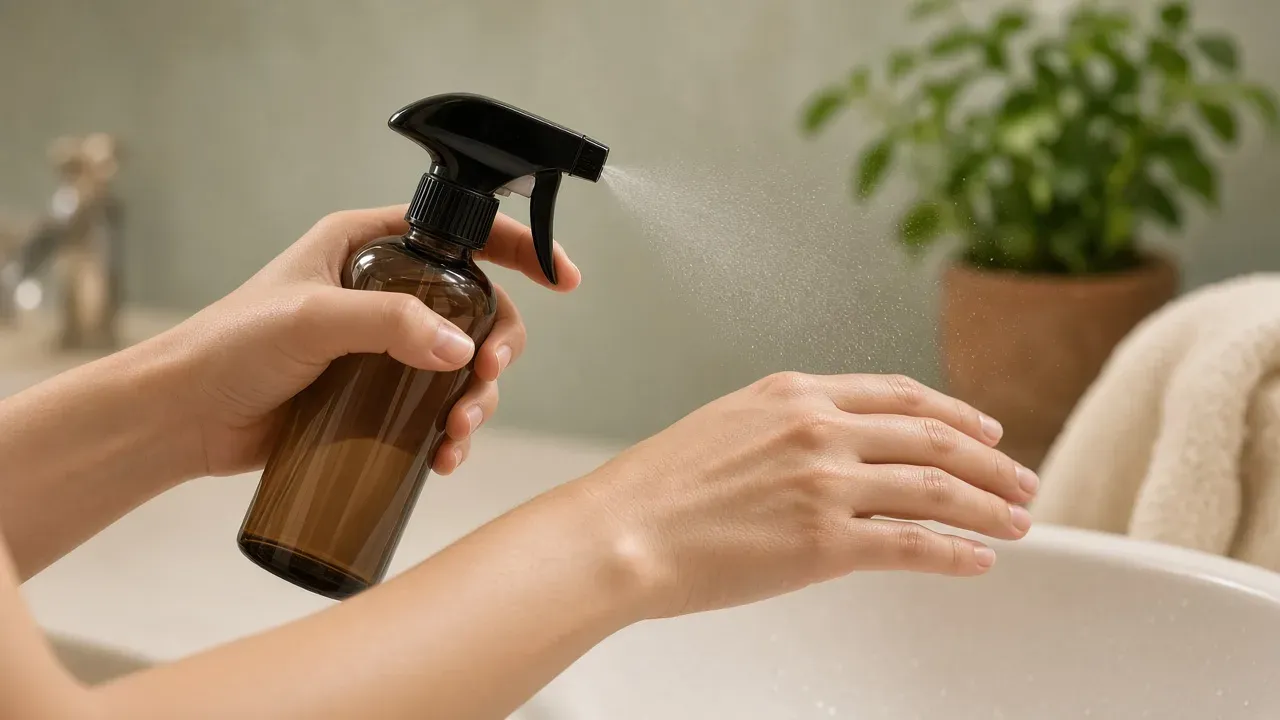
So here is how to use hypochlorous acid spray in a way that feels gentle and stays careful.
- Start with clean, dry hands and a clean face. Then pat your face mostly dry.
- Close your eyes and mouth. Never spray it into your eyes, nose, or mouth.
- Follow your product's directions for spray distance. The right distance gives you a fine, even veil instead of drips.
- Use the number of pumps your label suggests for face coverage. Aim for forehead, cheeks, nose, and chin.
- Let it air-dry or pat gently. Wait a moment before you add serum.
- Continue with your routine. Next, layer serum, moisturizer, and SPF in the morning.
Follow the label for how often to mist. Start once a day for the first week, then adjust only if your skin stays comfortable and the label allows it.
Also, if you prefer, mist onto a clean cotton pad and sweep it across your face, keeping well away from your lash line.
If your skin stings, burns, or turns red after a mist, stop and rinse with cool water. After all, a hypochlorous acid spray for sensitive skin should feel gentle.
Patch Test First, Even If It Feels Gentle
Every new product deserves a test run on sensitive skin.
The American Academy of Dermatology (AAD) lays out the steps on its page for AAD how to test products.
Here is how the AAD describes the process:
- Pick a quarter-sized spot where the product will not rub off, like the underside of your arm or the bend of your elbow.
- Apply the normal amount twice a day for seven to 10 days.
- Leave it on as long as you normally would.
- If no red, itchy, or swollen skin appears, go ahead and use it.
The AAD also explains that an ingredient, such as a preservative, can trigger allergic contact dermatitis. As a result, that reaction can make skin red, itchy, and swollen. So a water-like texture does not rule that out.
If you react, the AAD advises washing the product off gently and not using it again. Then a cool compress or petroleum jelly can help you feel more comfortable. If the reaction feels severe, a dermatologist can help.
Any hypochlorous acid spray should pass this test before it touches your face. Yes, ten days feels slow, but it can spare you a week of irritation.
What to Pair It With (and What to Space Out)
Simple partners work best with a gentle mist.
Think of hypochlorous acid skin care as one calm layer inside a short, supportive routine. A quiet kitchen habit, like when you stock a kitchen herbal apothecary, can pair with the same short-shelf mindset.
Good companions often include:
- Fragrance-free moisturizers. The AAD's dermatologists' tips for dry skin favor "fragrance-free" labels over "unscented" ones.
- Creams with ceramides, glycerin, or petrolatum. The same AAD page lists glycerin and petrolatum among ingredients worth looking for in a cream or ointment.
- Niacinamide serums. Also, some people with sensitive skin like this ingredient as a gentle, everyday serum step.
- A plain, broad-spectrum sunscreen. Morning protection rounds out any routine.
Now, the trickier part. Strong actives like retinoids, retinol, glycolic acid, and other exfoliating acids can irritate sensitive skin. Indeed, the AAD notes that retinol and glycolic acid can cause irritation, especially on sensitive skin.
You do not need to choose one or the other. Instead, just avoid stacking several strong products on the same night when your skin feels tight or reactive. On those days, then, keep it simple: cleanse, mist, moisturize, and rest.
A hypochlorous acid spray does not replace your moisturizer. Water alone evaporates, so always follow with a cream to lock in comfort.
How to Choose a pH-Balanced, Alcohol-Free Mist
A good label tells you a lot in a few lines.
Then use it to filter out formulas that may not suit a reactive face.
| What to look for | Why it matters |
|---|---|
| pH listed or described as balanced. | The NIH-hosted review links pH to how stable hypochlorous acid stays. |
| Alcohol-free. | Drying alcohols can leave sensitive skin tight. |
| Fragrance-free (not "unscented"). | The AAD explains "unscented" products can still contain masking chemicals. |
| Short ingredient list. | Fewer ingredients means fewer possible triggers. |
| Opaque or tinted bottle. | Shields the contents and supports a steadier formula. |
| Clear expiration date. | Tells you how long the maker expects the formula to last. |
| Cosmetic-only wording. | Signals an honest label without health promises. |
Short ingredient lists deserve extra attention. A basic hypochlorous acid spray often lists water, hypochlorous acid, and sometimes sodium chloride or a buffer. Also, every added botanical, scent, or extract raises the odds of a reaction.
The AAD cautions that "unscented" products and plant-based botanical ingredients may still carry fragrance-related ingredients. So "natural" on the front does not guarantee a gentle formula.
Of course, price tells you little. Instead, read the ingredient list, not the marketing.
Label Red Flags to Skip
Some labels raise doubts before you even open the bottle.
Once you learn these warning signs, you can shop faster.
Put the bottle back if you see:
- Disease claims on a cosmetic. Words that promise to fix acne, eczema, rosacea, wounds, or infections cross into drug territory under FDA definitions.
- Added fragrance or essential oils. These can irritate sensitive skin, and they add nothing essential to the mist.
- Drying alcohol near the top of the list. A tight, stripped feeling defeats the point of a calming step.
- No expiration date or batch code. After all, you cannot judge freshness without one.
- A clear bottle sitting in a sunny window display. Follow the label's storage note, and favor products the store keeps out of direct light.
- Instructions to drink, gargle, or spray in your eyes. A cosmetic face mist belongs on skin only.
Also skip any advice to make your own hypochlorous acid at home. Homemade versions skip the testing, stability control, and pH checks that the NIH-hosted review describes as central to how these solutions behave. Instead, buy a finished, labeled product.
Storage, Shelf Life, and Bottle Hygiene
Storage instructions count as part of the product.
Because hypochlorous acid formulas can lose freshness over time, the label tells you how to slow that down.
Start with the basics:
- Follow the label's storage note exactly.
- Keep the cap on tight between uses.
- Store it away from direct sun and heat, such as a sunny sill or a hot car.
- Check the expiration date when you buy and again every month.
Also, hygiene counts as much as storage. Do not touch the nozzle to your skin, and wipe it with a clean tissue now and then. Never pour the mist into another container, since a different bottle may not protect the formula.
If the scent changes sharply, the color shifts, or the spray starts to sting when it never did before, toss it. In contrast, a fresh hypochlorous acid spray should feel almost like nothing on your skin.
Buy a hypochlorous acid spray in a size you will finish before it expires. A small home-care habit, like when you make beeswax wraps at home, also rewards labels you can trust.
Realistic Expectations for Hypochlorous Acid Skin Care
Expect comfort and routine, not a transformation.
Instead, a mist adds a gentle, refreshing moment to your day. However, it does not rebuild your skin overnight.
Here is what hypochlorous acid skin care can realistically offer:
- A light, water-like layer after cleansing.
- A quick refresh after workouts or long mask days.
- A low-fuss step that many sensitive faces tolerate.
- A small ritual that makes your routine feel calmer.
Here is what it cannot promise: it will not fix acne, eczema, rosacea, wounds, or infections. The clinical research in the NIH-hosted review looked at specific medical formulations under expert supervision, not at a cosmetic mist from a store shelf.
Track how your face feels for a few weeks. Also, if you notice no difference, that is fine. A hypochlorous acid spray for sensitive skin earns its place by staying comfortable, not by delivering dramatic change.
Who Should Be Careful
Gentle products can still surprise you.
So take extra care, and ideally talk to a clinician first, if any of these apply:
- You have a diagnosed skin condition. Eczema, rosacea, psoriasis, or frequent rashes call for a dermatologist's input before you add new steps.
- You have broken, cracked, or raw skin. A cosmetic mist does not belong on damaged skin.
- You have reacted to many products before. Allergic contact dermatitis can come from preservatives or other ingredients in a formula.
- You use prescription skin products. Ask your prescriber how a new step fits with your plan.
- You want to use it on a child. Talk to a pediatrician or dermatologist before using any skin product on a child.
- You plan to use it near your eyes. Keep it away from your eyes unless a clinician recommends a product made for that area.
- You are pregnant or breastfeeding. Ask your clinician about any new skincare product if you feel unsure.
Store the bottle out of reach of children and pets.
None of this means you must avoid a hypochlorous acid spray. Instead, it means you should go slow, patch test, and ask questions.
When to See a Doctor
Some skin changes need a professional, not a new mist.
See a board-certified dermatologist or another clinician if you notice:
- Skin that burns or stings strongly after you apply the mist or any other product.
- Open wounds, cuts, or deep cracks that need proper care.
- Signs of infection, such as warmth, swelling, pus, increasing pain, or fever.
- A rash that spreads or appears in new places.
- Swelling of the face, lips, or eyes, which needs urgent attention.
- Skin that does not improve after a couple of weeks of a simple, gentle routine.
- Any skin concern in a child, including a rash or irritation that worries you.
The AAD notes that if a product reaction feels severe and does not ease with a cool compress or petroleum jelly, you may need to see a dermatologist. Also, a dermatologist can order medical patch testing to find what triggers your reaction.
Stop using the mist while you wait for your appointment. Then bring the bottle with you so your clinician can check the ingredient list.
This guide covers cosmetic use only and cannot replace an in-person exam.
Hypochlorous Acid Spray FAQ
These answers stay short and practical.
Each one rests on the same careful, cosmetic-only framing above.
Can I use hypochlorous acid spray every day?
Follow the label for daily use.
Some people mist once a day after a patch test, so start there. Stop if you notice stinging or redness, and do not exceed what the label allows.
Does it go before or after serum?
It goes before serum.
First cleanse, mist, and let it dry, then apply serum, moisturizer, and SPF in the morning.
Can I spray it over makeup?
You can, but bare skin works better.
A hypochlorous acid spray works best on clean skin. Over makeup, spritz lightly from farther away.
Is it safe to make at home?
No. Skip any homemade method.
Buy a finished, labeled product made for skin.
Can I use it with retinol?
Some people use both on different nights.
Still, space out strong actives when your skin feels reactive.
Will hypochlorous acid skin care clear my acne?
No cosmetic mist can promise that.
Instead, for acne or any skin condition, see a dermatologist.
Your Simple Starting Plan
Keep the first month boring on purpose.
After all, boring routines give sensitive skin the best shot at feeling calm.
Here is a simple plan to follow:
- Pick an alcohol-free, fragrance-free mist with a short ingredient list.
- Patch test for seven to 10 days, as the AAD suggests.
- Add it after cleansing, once a day, for one week.
- Follow with serum, moisturizer, and morning SPF.
- Increase only if your skin stays comfortable and the label allows more frequent use.
Now you know how to use hypochlorous acid spray with care, what to pair it with, and when to call a professional. A hypochlorous acid spray works best as a small, steady habit inside a short routine. Finally, if anything feels wrong, stop and ask a dermatologist.
You may also like
Sea Buckthorn Oil: A Beginner Guide for Winter-Dry Skin
This sea buckthorn oil guide explains fruit vs seed oil, why it can tint skin orange, how to blend it into cream, storag…
How to Use Gua Sha on Your Face: A Beginner's Step-by-Step Guide
How to use gua sha on your face: pick a jade gua sha or steel tool, find the best oil for gua sha, follow light strokes…
Fall Skin Barrier Reset When Indoor Heat Starts
Indoor heat dries skin fast. Use this autumn barrier reset for gentle cleansers, rich creams, humidifiers, and two-week…