Fall Foraging for Beginners: Wild Plant IDs, Ethics & October
A beginner fall foraging guide: build field guides, learn edible wild plants, spot poisonous berries, follow land rules, and leave plenty behind.
In this article
- What Fall Foraging Means for a Beginner
- Foraging for Beginners: The 100% ID Rule
- Build Your Field Guide Stack
- What to Look for in October
- The Never-Eat List: Identification Safety First
- Poisonous Berries: Rules of Thumb
- Permission, Permits, and Public Land Rules
- Ethics: Leave Some Behind
- Your Fall Field Kit and Journal
- Cleaning, Storage, and a Careful First Taste
- Who Should Be Careful
- When to See a Doctor
- Foraging FAQ
- Your First October Walk Starts With Looking
Fall foraging means walking local woods and field edges to find and identify wild plants, nuts, and fruit. This guide covers wild-plant foraging for adult beginners in October, not any of the other meanings of the word.
You will learn to observe first, confirm every ID, and leave plenty behind. Then October brings nuts, rose hips, and late fruit. It also brings shiny berries that can make people sick, so the safest approach puts learning ahead of eating. So go slow, take notes, and think of this fall as a study season. If you already tend outdoor plants, you can also plan a fall pollinator garden.
What you will get from this guide:
- A simple 100% ID rule and a plan for your field guides.
- An October table of learning targets and look-alikes to rule out.
- A never-eat list framed as identification safety.
- Clear rules of thumb for poisonous berries.
- Public land rules and leave-some-behind ethics.
- A field kit, a journal method, and a first-taste checklist.
From Our Garden
I have foraged roses and plants, and I find it relaxing.
That is one person's experience, not proof, and your results may vary.
What Fall Foraging Means for a Beginner
Your first fall is a learning season.
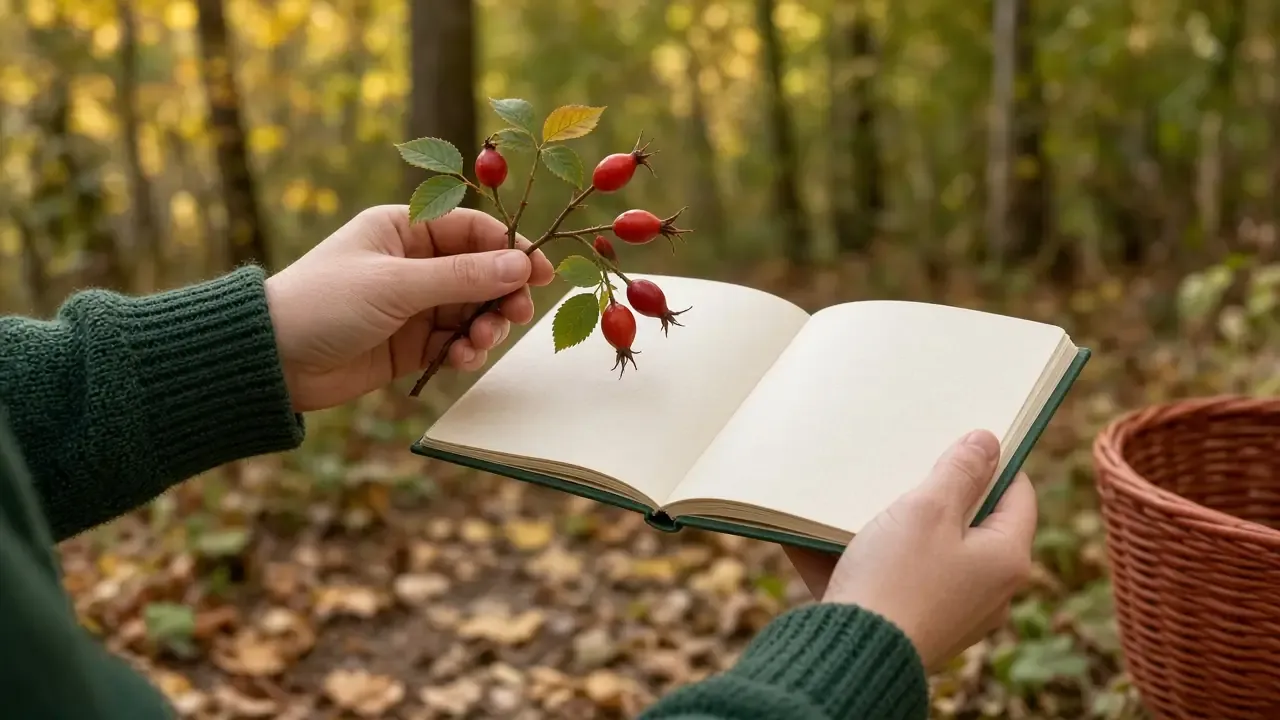
For a beginner, fall foraging means you study plants, habitats, and timing before you pick anything to eat. You walk a familiar loop, notice what changes each week, and build a mental map of your area.
Additionally, foraging is an adult activity. Kids can join a walk with close adult supervision, but they never eat anything they find. Poison Control fall berry guidance urges adults to watch children carefully outdoors. Also, teach kids to ask a grown-up before eating anything.
Instead, think of October as practice. You can photograph, sketch, and name a dozen edible wild plants and their look-alikes without tasting one. Overall, that habit builds the skill that keeps you safe: patient, repeatable identification.
Foraging for Beginners: The 100% ID Rule
One rule sits above every other foraging rule.
The MSU Extension wild edibles guide sets a high bar. Feel 100 percent certain of a wild plant's identity before you eat it. Likewise, you must feel certain it is not poisonous. Thus, if you feel almost sure, you are not sure.
Positive ID means you match several features, not one. First, check the plant as a whole. Check leaf shape and arrangement, stem texture, flowers or fruit, smell, habitat, and season. For example, a single feature like berry color can fool you.
MSU Extension also stresses that an edible plant may have toxic parts. Some plants need cooking to remove toxic compounds. Therefore, the guide warns that people should never eat pokeweed roots or berries. So a correct name alone does not finish the job.
Use this quick ID checklist on every plant:
- Name it in at least two guides, with matching photos and descriptions.
- Match leaf, stem, flower or fruit, and growth habit.
- Confirm that the habitat and season fit the guide.
- Rule out every look-alike the guides mention.
- Get a second opinion from a knowledgeable person.
When in doubt, leave it out. After all, MSU Extension gives that same advice, and it fits every walk you take.
Build Your Field Guide Stack
Good foraging starts with good books and good people.
MSU Extension recommends at least three different plant resource guides, with detailed descriptions, clear photos or drawings, and habitat notes. Pick regional guides, including at least one on edible wild plants, since look-alikes change from place to place.
Next, find a human teacher. Your county extension office can point you to walks and classes. Meanwhile, a native plant society or nature center can help too. Poison Control also suggests asking a park ranger or extension agent. Alternatively, ask a master gardener or plant nursery when you cannot name a plant.
However, apps can help you narrow the search, but they cannot confirm an ID. The Utah Poison Control foraging risks page cites a study on plant apps. Those apps correctly identified poisonous plants only 5.8% to 59% of the time. Use an app result as a hint that sends you back to your books.
The same center offers another simple rule: never go alone. A partner can double-check your find. Slow outdoor crafts pair well with this pace, and you can also try pressed flowers this fall.
What to Look for in October
October brings nuts, late fruit, and bright rose hips.
These make classic fall foraging targets, but each needs a confident ID. Use the table as a study list, not a menu.
| October learning target | What to rule out first | Beginner rule |
|---|---|---|
| Rose hips (Rosa spp.) | Red berries on other shrubs, such as holly, yew, or cotoneaster | Confirm the rose plant itself, not just the red fruit |
| American persimmon (Diospyros virginiana) | Any orange fruit you cannot confirm | Learn the tree with an expert where it grows |
| Acorns (oak) | Nuts or seeds you cannot name | Acorns contain tannins and need leaching before people eat them |
| Black walnuts and hickory nuts | Unknown nuts and seeds | Confirm the tree by leaf, bark, and husk |
| Wild apples (Malus spp.) | Small fruit on trees you cannot name | Confirm the tree, and check land rules first |
| Wild mushrooms | Deadly look-alikes | Skip them entirely as a beginner |
MSU Extension lists rose hips and persimmon fruit among common edible wild plants. The Blue Ridge Parkway gathering rules let visitors gather set amounts of persimmons, black walnuts, hickory nuts, and apples. Other parks can differ.
Acorns need extra work. The Lady Bird Johnson Wildflower Center at the University of Texas at Austin explains acorn leaching. People remove tannins with repeated changes of water. Learn that process hands-on from an experienced teacher.
Finally, keep your October list short. Instead, pick two or three targets and learn them well. Overall, depth beats variety in your first season.
The Never-Eat List: Identification Safety First
This list supports identification safety, not medical advice.
Therefore, skip these categories until an expert confirms otherwise in person.
- Wild mushrooms. Poison Control wild mushroom warning says never to pick and eat wild mushrooms unless an expert has identified them. Cooking does not make a poisonous mushroom safe, and symptoms can show up many hours later.
- Carrot and parsley family look-alikes. Poison hemlock resembles wild carrot. Utah Poison Control lists water hemlock as a look-alike for wild parsnip and wild parsley. The Ohio State poison hemlock factsheet notes that all parts of poison hemlock are highly toxic if eaten. It separates poison hemlock from wild carrot by its hollow, hairless stem with purple spots.
- Pokeweed berries and roots. Poison Control pokeberry look-alike tips says the entire pokeweed plant is poisonous. Its purple berries hang in grape-like clusters on red stems.
- Yew, holly, and similar shrubs. The Children's Hospital of Philadelphia Poison Control Center names common poisonous berries in its region. Those include American bittersweet, cotoneaster, holly, juniper, pokeweed, and yew.
- Wild onion look-alikes. Utah Poison Control lists death camas as a look-alike for wild onion and ramps.
- White or unknown berries. Many white berries cause trouble, so skip every berry you cannot name with certainty.
This list targets common plants, not obscure ones. Ohioline notes that parsley family weeds turn up on roadsides, ditches, and forest edges. Consequently, familiar spots can still hide a dangerous plant.
Poisonous Berries: Rules of Thumb
Berries tempt beginners more than anything else in fall foraging.
Poison Control notes that some wild berries are poisonous, while a few are edible. Even so, non-poisonous ones can still cause nausea, vomiting, and diarrhea. That mix makes poisonous berries the top risk on many October walks.
Use these rules of thumb every time:
- Never eat a berry you cannot name with 100% certainty.
- Skip white berries and any berry an expert has not confirmed.
- Identify the whole plant, not just the fruit. Check leaves, stems, and growth habit.
- Never rely on birds or animals. The University of Kansas Health System Poison Control Center warns against a common mistake. Never assume a wild berry is safe for people because an animal eats it.
- Look closely at clusters. Poison Control explains that pokeberries resemble grapes, but adults can tell them apart by their red stems.
In fact, look-alikes drive most mistakes with poisonous berries. Red fruit on an evergreen shrub could come from holly or yew. CHOP describes yew berries as soft red capsules with a hard green stone in the center. In contrast, it describes cotoneaster berries as bright orange clusters.
Therefore, build a habit of comparison. When you find a berry, write down two plants it resembles and what separates them. If you cannot list the differences, you do not know the plant yet. That practice keeps poisonous berries out of your bag.
Permission, Permits, and Public Land Rules
Above all, legal access comes before any harvest.
MSU Extension says to always seek permission before gathering on private land. It also notes that most public lands, such as parks and refuges, limit gathering. Many ban it outright or require a permit.
For instance, national parks follow a clear federal rule. The regulation at 36 CFR 2.1 plant protection rules prohibits disturbing or removing plants in park areas. The exception covers fruits, berries, nuts, or unoccupied seashells. A superintendent must designate them for hand gathering for personal use, within set limits.
The Blue Ridge Parkway shows how specific those rules get. Its compendium names each allowed species, sets daily limits, and bans climbing trees to gather fruit and nuts. Another park can set different rules.
Similarly, national forests work differently again. Mt. Hood National Forest lets visitors collect small personal-use amounts of some products without a permit. It bans harvest in places like wilderness and research natural areas. Furthermore, it bans selling those finds, and each harvester must know the rules.
Before every outing:
- Find out who owns or manages the land.
- Read that unit's current rules, not a general article.
- Ask a ranger or district office when anything feels unclear.
Ethics: Leave Some Behind
Ethical foraging leaves a place as healthy as you found it.
MSU Extension advises taking no more than one-third of any plant or plant population in one location. As a beginner, then, take far less.
Mt. Hood National Forest lists sustainable habits worth adopting anywhere. It asks harvesters to take only what they need and avoid stripping leaves from berry bushes. Then spread out your impact, and leave some behind for wildlife. It also says never to collect threatened, endangered, or sensitive plants or fungi.
In fact, where you harvest matters as much as how much. MSU Extension warns against gathering along roadsides, power lines, and industrial zones. Plants can absorb herbicides, pesticides, heavy metals, and runoff. Skip sprayed lawns, ditches, and the edges of busy roads. Fall garden work pairs well with this care, and you can also plant garlic in fall beds.
Your ethics checklist:
- Take a small share, and never strip a patch.
- Leave plenty for birds, squirrels, deer, and insects.
- Skip any plant that might be rare or protected.
- Stay on trails where rules require it.
- Pack out trash, including what others left behind.
Your Fall Field Kit and Journal
A light kit makes every foraging walk safer.
A few basics help you identify carefully and keep finds separate.
| Item | Why it helps |
|---|---|
| Gloves | Protect hands from sap, thorns, and irritating plants |
| Paper or mesh bags | Keep each species separate |
| Labels and a pen | Mark species, place, and date on each bag |
| Phone or camera | Capture the whole plant, leaves, stem, and fruit |
| Hand lens | Shows small hairs, spots, and textures |
| Notebook | Records what you saw and what you still need to check |
Indeed, gloves matter more than you might think. Ohioline explains that sap from wild parsnip, cow parsnip, and giant hogweed can cause severe skin reactions after sun exposure.
Your journal turns walks into skill. For each plant, note the date, location, habitat, leaf shape, stem details, fruit, and any look-alikes you ruled out. Add a photo reference and a confidence score from one to five.
Over a season, that notebook shows patterns, like when fruits appear and which IDs still need an expert's eye. That record supports the slow, careful habit that lasts for years.
Cleaning, Storage, and a Careful First Taste
Handle foraging finds like produce from an unknown farm.
First, sort everything at home, one species at a time. Toss anything damaged, moldy, or uncertain.
Next, rinse fruit in clean water and dry it well. Store each species in its own labeled container, and use fresh fruit soon.
Of course, a first taste needs more caution than a full meal. Only consider it after your guides and an expert confirm the ID. MSU Extension advises eating wild edible plants in moderation and notes that everyone has personal sensitivities.
Follow these first-taste rules:
- Taste only a small amount the first time.
- Try one new wild food at a time, never a mix.
- Wait and notice how you feel before you try anything else new.
- Keep a sample and a photo of what you ate.
- Skip it entirely if you have allergies to related foods.
Poison Control notes that even non-poisonous mushrooms can cause unpleasant reactions in sensitive people. Your body may react differently from someone else's.
Who Should Be Careful
Some people need extra caution or should skip wild foods entirely.
Foraging stays an adult activity, and these groups deserve special attention:
- Children. Kids can walk and look under close adult supervision, but they never eat anything they find. Poison Control advises teaching kids to ask a grown-up before eating anything. The Kansas center advises teaching them never to put seeds, nuts, or berries from any plant in their mouths.
- People with food allergies. Talk with your doctor or allergist before you try a new wild food.
- Pregnant or breastfeeding people. Ask your health care provider before eating any new wild food.
- People with health conditions or on medications. Check with your doctor or pharmacist first.
- People with sensitive skin. Sap from some parsley family plants can cause severe skin reactions with sunlight, so wear gloves and long sleeves.
- Pet owners. Keep dogs close and away from berries and mushrooms, and call your vet with questions.
Meanwhile, watch your own confidence, too. Poison Control's mushroom article notes a striking pattern. Almost all the people it helped with mushroom poisoning felt sure they had picked a safe mushroom. Certainty without verification counts as a risk.
When to See a Doctor
This section helps you act fast and does not replace medical care.
If someone eats a plant, berry, or mushroom you cannot identify, call right away. Contact Poison Control at 1-800-222-1222 in the US. Poison Control fall berry guidance offers free, confidential expert help 24 hours a day. You can call or use its online tool.
Also, call 911 or emergency services right away for severe symptoms. Those include trouble breathing, seizures, fainting, confusion, or a person who will not wake up. Do not wait for symptoms after someone eats a wild mushroom. Poison Control warns that symptoms can show up many hours later.
Contact Poison Control or a doctor in these situations too:
- Vomiting, diarrhea, or stomach pain after eating a wild food.
- A skin rash, blisters, or burning that spreads after plant contact.
- Plant sap or juice in the eyes.
- Any reaction in a child, even a mild one.
- Any doubt at all about what someone ate.
Afterwards, bring information with you. CHOP suggests taking a 6- to 8-inch cutting with leaves, berries, and flowers for identification. In addition, that information helps the Poison Control Center. A clear photo of the whole plant helps too.
Foraging FAQ
Is foraging legal where I live?
It depends on the land. Private land needs the owner's permission, and public land follows its own rules. National parks allow gathering only for items a superintendent designates, so read the local compendium first.
What are good edible wild plants to start with?
Start with plants your local experts teach in classes, since regions differ. MSU Extension lists rose hips, persimmons, and several berries among common edible wild plants. Still, every one needs a confirmed ID.
How can I spot poisonous berries?
You cannot rely on one trait. Learn the whole plant, compare look-alikes, and skip anything uncertain. Never assume a berry is safe because birds or animals eat it.
Should beginners include mushrooms?
No. Poison Control says never to eat wild mushrooms unless an expert has identified them. Photograph them instead.
Can I bring my kids along?
Yes, as observers under close adult supervision. Kids can look, photograph, and learn names, but they never eat what they find.
Do I need a permit on public land?
Often yes, or the unit bans gathering outright. Read that unit's current rules, ask a ranger when unclear, and never assume one park matches another.
Your First October Walk Starts With Looking
Pick a nearby park or trail where you know the rules.
Then bring a notebook, a camera, and one regional guide. Spend an hour naming what you see, and harvest nothing on your first trip.
Afterwards, come back next week and notice what ripened or dropped. Next, book a class with your local extension office or a native plant group, and bring your questions. Over time, fall foraging becomes a calm, curious habit. It rests on patience, respect for the land, and IDs you can stand behind.
You may also like
Clover Lawn: How to Overseed in Fall for a Low-Mow Yard
This clover lawn guide covers fall overseeding timing, microclover vs white clover, six planting steps, watering, mowing…
Plant Propagation for Beginners: 8 Easy Houseplants From Cuttings
New to plant propagation? Learn water and soil rooting, eight easy houseplants to grow from cuttings, an indoor fall set…
Indoor Herb Garden Before Frost: Cuttings and Light
Pot one clean herb or root a few green stems this weekend, then set it in real sun or under a basic lamp before nights t…