Creatine for Women Over 40: Dose, Myths, and Perimenopause Evidence
Should you take creatine after 40? The right daily dose, what perimenopause research really shows, and 6 myths that still scare women away

In this article
- Why Creatine for Women Over 40 Hits Differently
- Creatine Perimenopause: Promise, Not a Finished Chapter
- Creatine Dosage for Women Over 40: Simple Beats Fancy
- How to Choose a Good Creatine Supplement
- Myths That Still Scare Women Away
- How to Use Creatine as Part of a Midlife Plan
- What a Realistic Timeline Looks Like
- Safety Snapshot
- Creatine for Women Over 40: FAQ
- Putting It All Together
You notice it in small ways first. The grocery bags feel heavier. Recovery after a weekend hike takes longer. Brain fog shows up on days you used to power through. If you are over 40, especially if your cycle is getting unpredictable, you are not imagining the shift. Muscle, bone, mood and energy all face new pressure as estrogen swings and then declines.
That is why creatine for women over 40 has moved from “gym bro supplement” to a serious topic in women’s health research. Creatine is one of the most studied sports supplements on earth. Yet for decades, most studies left women out. Newer reviews are closing that gap, and the midlife window is where the story gets really interesting.
This guide explains what creatine does, how to think about creatine dosage for women over 40, what we know (and do not know yet) about creatine and perimenopause, and which myths you can safely ignore.
What you will get from this article:
- A clear explanation of why creatine matters more after 40.
- Practical dosing options, with and without a loading phase.
- An honest look at perimenopause evidence versus postmenopausal data.
- Myth-busting on kidneys, “bulking” and “women don’t need it”.
- A simple way to pair creatine with strength training.

Why Creatine for Women Over 40 Hits Differently
Creatine helps your cells recycle ATP, the quick energy your muscles and brain use for short, hard efforts. Your body makes some creatine, and you get more from meat and fish. However, women store less creatine than men on average. They tend to have less muscle and eat less creatine-rich food.
After 40, several forces stack up:
- Muscle loss speeds up. Without strength training, lean mass declines year after year. Less muscle means a slower metabolism, weaker joints and a higher risk of falls later.
- Estrogen shifts change the picture. Estrogen affects how your muscles store and use energy. As levels swing in perimenopause and drop after menopause, the buffer you relied on for recovery can feel thinner.
- Recovery gets less forgiving. The same workout that once left you sore for a day can now linger for three. So supporting your energy stores is one lever that does not need another hour in the gym.
Creatine will not replace sleep, protein or lifting. But it can make those habits pay off more, especially while your hormones change. Think of it as topping up a tank your body already uses. It does not create a new hormone pathway. For most women, that “top-up” view is far more useful than any hype.
Also, creatine works best next to good food. A protein-rich morning meal helps, so browse our healthy breakfast ideas made with whole foods for easy options.
Creatine Perimenopause: Promise, Not a Finished Chapter
Search “creatine perimenopause” and you will find a lot of excitement. Still, there is less direct research than the hype suggests. A recent review on creatine across the female lifespan noted a clear gap. So far, no dedicated randomized trials have enrolled women confirmed to be in perimenopause.
That does not mean creatine is useless in this phase. It means we draw conclusions from three sources:
- Stronger data in postmenopausal women. These women are often in their late 50s or early 60s. In their trials, creatine plus strength training gives small but real gains in lean mass and strength.
- How the body works. Perimenopause brings swinging estrogen, body changes, hot flashes, fatigue and brain fog. Creatine shows promising support for several of these areas in other groups.
- Overlapping ages. Some “postmenopausal” trials include women whose ages overlap late perimenopause, even when nobody checked their cycles.
So here is the honest view. Creatine in perimenopause is a top research priority and a reasonable, low-risk experiment for many healthy women. However, it does not have its own stack of trials yet. If someone sells you a “clinically proven perimenopause protocol”, ask which trials actually enrolled women in perimenopause.
What You Can Reasonably Expect
Based on the nearby evidence, here is what creatine may offer:
- Better training quality and strength gains when you lift regularly.
- Modest help holding on to lean muscle.
- Possible support for fatigue and mental energy, though this data is still early.
- No reliable promise of denser bones from creatine alone.
What About Bone Health?
Longer trials in older women have not shown clear gains in bone density from creatine by itself. Some research, however, suggests benefits for bone shape and strength when women pair creatine with exercise. That is good news for fracture risk over the decades. Still, it is not the same as “creatine reverses osteoporosis”, so keep your hopes realistic.
One more tip for the perimenopause years: symptoms change from week to week. If you try creatine, track it for a full month of steady use. Do not judge it during one rough week of poor sleep or heavy training. Women who try creatine for women over 40 often find that patience beats week-one scale drama.
Creatine Dosage for Women Over 40: Simple Beats Fancy
Skip the complicated stacks. For most women, the evidence points to creatine monohydrate. It is the cheap, well-studied form, and a steady daily dose works best.
Option A: Daily Maintenance (Most Sustainable)
Take 3 to 5 g of creatine monohydrate every day, with no loading phase. Your muscles usually fill up in about three to four weeks. Most women stick with this approach, because it is simple and gentle on the stomach.
Option B: Optional Loading, Then Maintenance
Take about 20 g per day, split into four doses of 5 g, for 5 to 7 days. Then drop to 3 to 5 g daily. Loading fills your stores faster. However, it is not better in the long run, and it can cause more water retention or stomach upset at first.
What the Midlife Data Favors
A recent meta-analysis in postmenopausal women found the clearest benefits for lean mass and strength at about 5 g per day or more, combined with strength training. In contrast, trials using 3 g per day or less without training often showed little effect. That is a key point for creatine dosage for women over 40: the powder does not replace progressive lifting.
Here is a simple rule of thumb:
| Your goal | Suggested approach |
|---|---|
| General support and strength training | 5 g per day of creatine monohydrate. |
| You prefer to start slowly | 3 g per day for 2 to 4 weeks, then move toward 5 g if you feel fine. |
| You want faster results | Load 20 g per day (split) for 5 to 7 days, then 5 g per day. |
| You are curious about brain focus | Some protocols use higher short-term doses, so talk to a doctor first. |
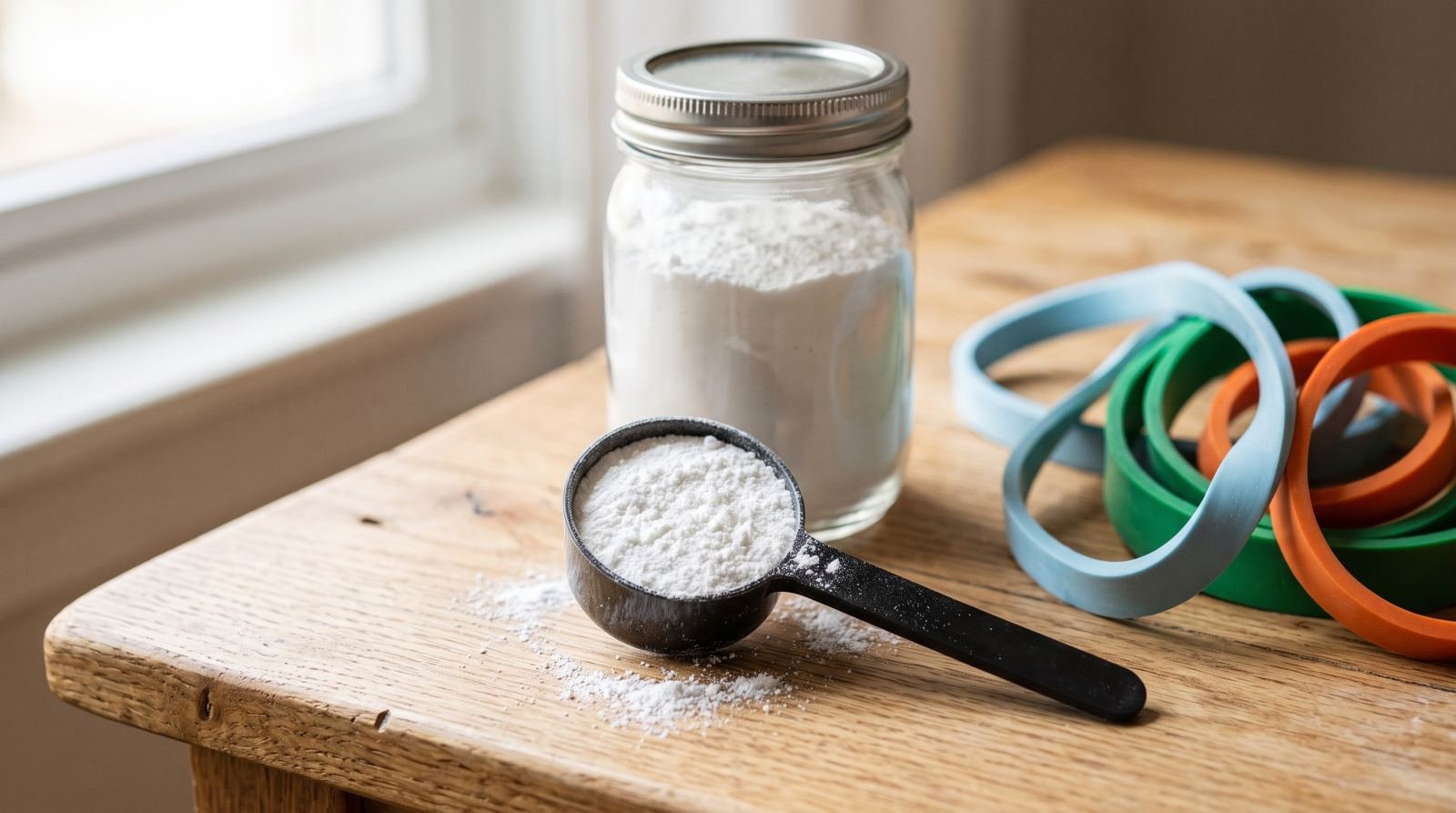
Timing, Form and Scoop Size
Take creatine at any time of day, because consistency beats timing. If your stomach is sensitive, mix it with a meal or a snack. Also stay hydrated as you normally would when you train. You do not need to “flood” yourself with water.
Creatine monohydrate is the default form. Fancy blends rarely beat it in head-to-head tests. A level scoop of about one teaspoon usually lands near 5 g, but weigh it once if you are unsure. So what does creatine dosage for women over 40 look like in real life? It is almost boring: one steady scoop, most days, next to a real training plan.
How to Choose a Good Creatine Supplement
The supplement aisle is full of flashy tubs, but a good creatine product is simple. First, check the label. It should say “creatine monohydrate” as the only ingredient, with no sugar, dyes or proprietary blends.
Next, look for third-party testing. Independent labs check that the powder contains what the label claims and nothing more. This matters, because supplements do not go through the same approval process as medicines. Our guide on how to read labels and avoid greenwashing shows you how to spot vague claims.
Finally, choose unflavored powder if you can. It mixes into coffee, smoothies, yogurt or water without any taste. It also costs less. In fact, a good tub of plain creatine monohydrate often lasts two to three months for a few dollars a week.
Myths That Still Scare Women Away
Myth 1: “Creatine Damages Your Kidneys”
In healthy people, research has not shown real kidney harm at standard doses. Creatine can raise creatinine on blood tests, which sometimes worries doctors who do not see the full picture. However, if you already have kidney disease, take drugs that affect your kidneys or have a complex medical history, talk to your doctor before you start. That is caution, not panic.
Myth 2: “It Will Make Me Bulky”
Creatine does not flood you with testosterone. Any early scale jump is usually water inside your muscle cells, not sudden bodybuilder mass. The “bulk” women fear comes from years of heavy training and extra calories, not from a teaspoon of powder.
Myth 3: “Creatine Is Only for Young Male Athletes”
Women start with lower creatine stores on average. Also, midlife women lose muscle and strength when they stop challenging it. Calling creatine a men-only product is old marketing, not science. That is one reason interest in creatine for women over 40 keeps growing in clinics and gyms alike.
Myth 4: “If It Worked, Every Doctor Would Prescribe It”
Medicine moves slowly, and research on women in midlife gets little funding. Also, supplements sit outside the prescription system. So its absence from your yearly checkup does not prove it is useless. Still, it is no excuse to ignore medical advice. Use evidence, not Instagram.
Myth 5: “More Is Always Better”
Mega-dosing for months does not bring mega-results. Instead, stay near the studied range unless a doctor supervises a specific protocol.
Myth 6: “I Already Eat Meat, So I Don’t Need It”
Food creatine helps, but the doses from studies are hard to reach with food alone. A portion of beef or fish adds some creatine. It does not reliably deliver 5 g every day.
For trusted background, read the ISSN position stand on creatine safety and efficacy and the fact sheets from the NIH Office of Dietary Supplements.
How to Use Creatine as Part of a Midlife Plan
Think of creatine as a supporting actor, not a magic fix. Your lead roles are still these four habits:
- Strength training 2 to 4 days a week. Squats, hinges, pushes, pulls and carries all count. Steady progress matters more than perfection. If you are new to lifting, two full-body sessions per week still pair well with creatine.
- Enough protein. Many midlife women eat too little. Experts often suggest about 1.2 to 1.6 g per kilogram of body weight per day for older adults. A dietitian can help you find your number.
- Sleep and stress care. Creatine cannot fix chronic sleep debt or a calendar that never stops. Time outdoors helps too, so try our gentle forest bathing guide for beginners.
- Medical context. Hormone therapy, thyroid health, iron levels and joint issues all affect how you feel and train.
A Real-Life Example
Maya, 47, is in perimenopause. She has irregular cycles, weaker pull-ups and afternoon brain fog. She starts taking 5 g of creatine monohydrate daily. She also eats more protein at breakfast and lunch, and she follows a three-day full-body strength plan.
Eight weeks later, her scale is up two pounds, but her jeans fit the same. Meanwhile, her rows and goblet squats are clearly stronger. That pattern, slight water weight and better training, is a common success story. If the scale were her only measure, she might have quit in week two.
Another Quick Check
What if you feel no change after four steady weeks? First, check the basics before you blame creatine. Are you lifting hard enough to progress? Is your protein steady? Are you missing doses three days a week? Creatine rewards consistency more than perfection on any single day.
What a Realistic Timeline Looks Like
Week 1 is mostly about habits. You pick a monohydrate, set a daily cue and notice whether your stomach complains. Some women see a small scale bump from water inside the muscles. That is storage, not fat gain.
Weeks 2 to 4 are when muscle stores usually level out if you take 3 to 5 g daily without loading. So this is the time to watch your workouts: an extra rep on a hard set, a cleaner final set of lunges, less “flat” feeling on leg days.
After a month, creatine is about maintenance. It keeps supporting strong training while you add weight over time. If you stop taking it, your stores slowly drop over several weeks. There is no rebound effect. You simply lose the extra edge.
Safety Snapshot
For healthy adults, creatine monohydrate at 3 to 5 g per day has a strong safety record. Mild bloating or stomach upset usually settles when you split the dose or take it with food. However, stop and see a doctor if you notice unusual swelling, severe stomach problems or anything that feels wrong.
Also, do not experiment alone if you are pregnant or breastfeeding. The same goes for kidney, liver or bipolar conditions: talk to your doctor first. Natural does not mean right for everyone.
Creatine for Women Over 40: FAQ
Is creatine for women over 40 safe?
For most healthy women, yes, at standard doses. Still, share your full medication list and kidney history with a doctor if you have any doubt.
Do I need to cycle off creatine?
No. Daily, non-stop use is the norm in research. Cycling is a personal choice, not a rule.
Will creatine help hot flashes?
There is no solid evidence that creatine treats hot flashes. Any benefit you feel likely comes from better training, better sleep or placebo. So track it, but do not count on it as a hot flash treatment.
Can I take creatine with HRT or other medications?
Often yes, but check with your prescriber first. Creatine has no well-known major drug interactions. Still, your own treatment plan matters.
What if I am vegetarian or vegan?
You may benefit even more, because you get very little creatine from a plant-based diet. The same 3 to 5 g monohydrate approach applies.
How long until I notice anything?
Strength and training gains often show within a few weeks once your stores are full. Body changes, if any, come more slowly. So give the experiment a fair month.
Putting It All Together
If you are exploring creatine for women over 40, you do not need a complicated plan. Choose creatine monohydrate and commit to about 5 g daily with regular lifting. Also stay honest about creatine and perimenopause: the biology is promising, direct trials are few, and the postmenopausal evidence is solid.
Give it at least four weeks of steady use with strength work before you judge it. Then measure progress in reps, recovery and how your clothes fit, not only on the scale.
Ready to try it? Pick a start date, put the tub next to the coffee maker and treat 5 grams like brushing your teeth: boring, daily and quietly powerful.
This article is for general education and does not replace medical advice. Talk to your doctor before you start any supplement, especially if you have a health condition or take medication.
You may also like

3 Easy Cabbage Recipes for Cozy Winter Dinners
Try three cabbage recipes for cozy winter dinners: roasted steaks, cabbage dumplings, and unstuffed cabbage soup, plus s…

What Is Astaxanthin? The Pink Antioxidant in Salmon and Algae
What is astaxanthin? Explore astaxanthin foods, the algae-to-salmon food chain, natural and synthetic forms, the researc…
How to Make Pumpkin Pie Spice (and 4 More Fall Spice Blends)
Here is how to make pumpkin pie spice at home with exact ratios, plus an apple pie spice recipe, chai, gingerbread, mull…